
Foundation Drain Installation in Shreveport, LA

Water pooling around the house after rain. Standing water at the foundation that takes days to go. Water under the house, in the crawl space, after every heavy storm. That water is doing damage: it soaks the clay under the house, the clay swells, and when it dries out it shrinks, and that is what cracks slabs and sticks doors in Shreveport. We install foundation drainage in Shreveport and Bossier City: downspouts piped away from the house, the grade corrected so water sheds away from the slab, and a perimeter French drain along the sides that still collect water. Call (318) 216-6513 for a free look and a written price.
Why water collects against the house
Three reasons, and most houses have at least two. The downspouts drop the whole roof's worth of rain within a foot of the foundation. The ground next to the house has settled over the years and now slopes toward it instead of away. And the soil is heavy clay that will not soak the water up, so it sits where it lands. On a pier-and-beam house the water runs straight under the floor. On a slab it sits against the edge and works underneath.
Fix those three and the wet strip along the house, the flooded beds and the damp crawl space go away. In that order: roof water first, because it is the biggest share and the cheapest to fix; grade second; and a drain along the wall only where the first two are not enough.
The three fixes
1. Downspouts piped underground. Solid pipe from each downspout to an outlet away from the house. On a lot of Shreveport houses this alone dries out the foundation. Detail on the downspout drainage page.
2. Grade corrected along the house. The soil next to the foundation built up and shaped so it falls away from the house for the first several feet. Beds are reset on top. Detail on the regrading page.
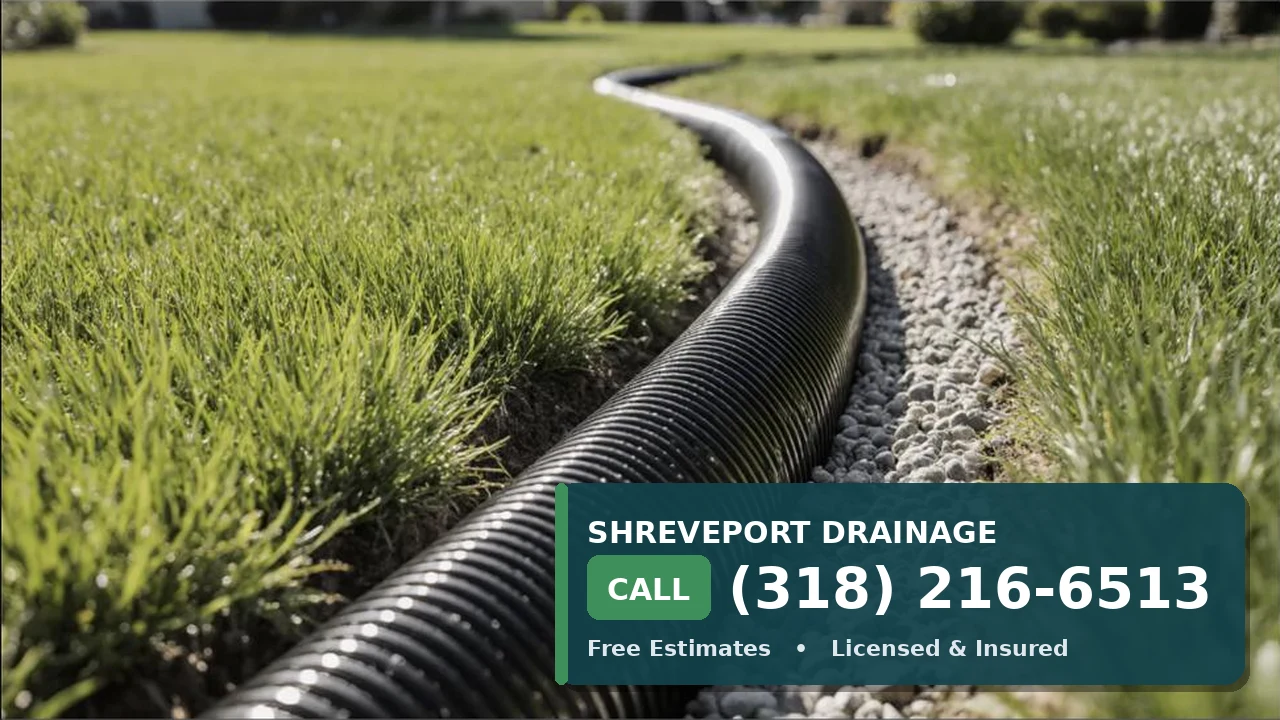
3. A perimeter French drain. Along the side or sides that still hold water: a trench next to the foundation, below the level where the water sits, with fabric, gravel and perforated pipe, carrying the water to an outlet. Downspouts on that side are usually tied into the same run. On a crawl-space house the drain can go inside the crawl space instead, feeding a sump pump where there is no fall to an outlet. Detail on the French drain installation page.
We quote the three as one job when the house needs all three, because they share trenches and an outlet and it is cheaper done together.
What foundation drainage costs in Shreveport
A perimeter French drain along one or two sides of the house with the downspouts tied in usually runs $3,000 to $12,000. What moves the number is how many sides need it, how deep the trench has to go, how far the outlet is, and what is in the way: a patio, an air conditioner pad, a driveway. Downspouts piped away on their own are $500 to $2,500. Regrading along the house is $1,500 to $6,000. Every price on the site is on the Shreveport drainage cost page.
Prices on this page are estimates from previous work. We cannot quote an exact price. The actual cost can be lower or higher depending on the job. The person who knows is the professional who will do the work. You get a written quote after we see the house.
Drainage first, foundation repair second
If the house has already moved, cracks in the slab or the brick, doors that stick, floors out of level, a foundation repair contractor will need to look at it. But piers and levelling do not last if the water that caused the movement is still sitting against the house. Drainage comes first, and any foundation contractor worth hiring will tell you the same. If you are not sure which you need, call and describe what you are seeing; we will tell you straight whether it is a drainage job, a foundation job, or both.
How to get started
Call (318) 216-6513 and tell us which side of the house holds water, whether it is a slab or a crawl space, and how long the water stays after rain. We book the visit, ideally after rain, and give you a written price. If you would rather write, use the contact page.
Related services
Foundation drainage questions
How do I stop water pooling around my house?
Three things, usually in this order. Pipe the downspouts underground and away from the house, because the roof is most of the water. Correct the grade so the ground next to the house falls away from it instead of toward it. And where water still collects along a wall, a French drain along that side, below the level where the water sits, carrying it to an outlet. Most Shreveport houses need the first two; the wettest side gets the third.
How much does foundation drainage cost in Shreveport?
A perimeter French drain along one or two sides of the house with the downspouts tied in usually runs $3,000 to $12,000, depending on the length, the depth and what is in the way. Downspouts alone are $500 to $2,500. Regrading along the house is $1,500 to $6,000. You get a written price after someone has walked round the house after rain.
Is water under the house after heavy rain a drainage problem or a foundation problem?
It starts as a drainage problem and becomes a foundation problem if it is left. Water sitting against the slab or in the crawl space makes the clay under the house swell, then shrink when it dries, and that movement is what cracks slabs and racks door frames. Getting the water away from the house is the first job; if the house has already moved, a foundation repair contractor comes after the drainage, not instead of it.
Does a slab house need a foundation drain?
Not every one. If the downspouts are piped away and the ground falls away from the slab, most slab houses in Shreveport stay dry. A perimeter drain is for the houses where water still sits along a wall after those two are done, usually the side facing the neighbour's higher lot or the side with no fall at all.
How long does foundation drainage take?
Downspouts and regrading are usually one day. A perimeter French drain along one or two sides with the outlet run is two to three days. The beds and lawn are put back when we finish.
Do you do foundation drainage in Bossier City?
Yes. Shreveport, Bossier City, Haughton, Benton, Blanchard, Greenwood, Stonewall and Keithville. Call (318) 216-6513.
Water against the house? Call now.
(318) 216-6513. Free look, written price, no obligation.